

The Ending Of Premonition Explained

Mennan Yapo's "Premonition" is one of the most notable entries from the crop of paranoia thrillers that came out in the 2000s, a relic from a time when a movie could be trusted to brave the box office on just a simple combination of star power and effective, adult-oriented storytelling. In the case of 2007's "Premonition," which stars Sandra Bullock, that trust paid off: The movie grossed $84 million worldwide against a budget of $20 million. Although critical reviews have been less than stellar, it's a movie that's very much worth watching if you're a fan of moody, twisty, puzzle-box suspense, which explains why "Premonition" is finding brand new fans on Netflix.
If you're one of those newcomers, you may have been left with some questions about the conclusion of "Premonition." Not only is the ending dense in information, but the whole story leading up to it is pretty mind-bending thanks to its nonlinear structure. Thankfully, we've prepared an explainer about the ending of this fascinatingly labyrinthine movie. Read on for a detailed explanation of what happens at the end of "Premonition," how that ending relates to the film's scrambled plot, and what deeper conclusions can be drawn from the ending.
What is the plot of Premonition?
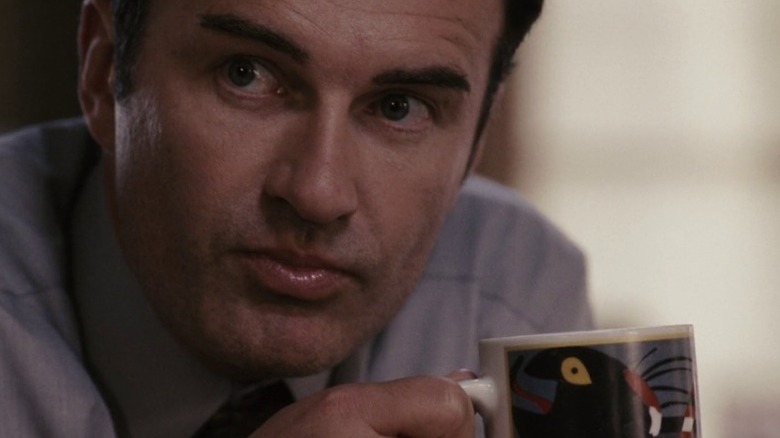
"Premonition" is about stay-at-home mother Linda Hanson (Sandra Bullock), whose marriage to her husband, Jim Hanson (played by Julian McMahon, who sadly died in 2025), is on the ropes. One day, while waiting for Jim to drive back home from an out-of-town work trip, Linda gets the news that her husband has died in a car accident. After just one day of hectic mourning, Linda's life is thrown into surreal chaos when she wakes up to find out that Jim is still alive and has seemingly never made the trip. She assumes that Jim's death was a nightmare and goes about her day — but then, when she wakes up the day after that, she finds her house occupied by the attendees of Jim's funeral service.
Eventually, Linda comes to understand what's going on: For inexplicable reasons, she's experiencing her days out of order, jumping forward and backward in time in a seemingly random manner every time she goes to sleep. Realizing that she will be living out the days that will lead up to Jim's passing, she begins to twist herself into knots trying to make sense of her life's timeline and decipher the cause-effect relations between different days. Soon enough, she's making a pained effort to keep Jim's death from ever occurring — until the discovery that Jim was having an affair with his work colleague, Claire Francis (Amber Valletta), leaves Linda uncertain about whether she actually wants to save her husband at all.
What happens at the end of Premonition?
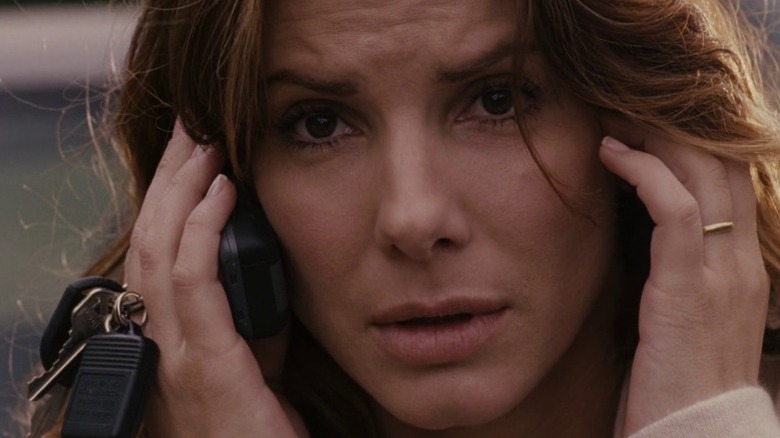
In the finale of "Premonition," we finally reach the beginning of the film, so to speak. Linda wakes up on Wednesday, the day of Jim's death in the timeline, and finds a note from Jim informing her that he has gone to drop off their daughters, Bridgette (Courtney Taylor Burness) and Megan (Shyann McClure), at school, and will make his trip after that. While Linda scrambles to deal with the imminence of the accident, Jim calls Claire, who is waiting for him at the hotel, and breaks off their affair before it can be consummated.
Tailing Jim by car, Linda calls him while he's leaving her the voicemail that she heard at the start of the film. They have a tearful, heartfelt conversation in which Jim opens up about his affair. Linda reveals that she already knew about it, and they both endeavor to fight to rebuild and heal their marriage. Linda then realizes that they're nearing the marker on the highway (the location of which is unspecified in the movie, but "Premonition" was actually filmed in Louisiana) where the accident occurred and begs Jim to turn the car around and head back home.
Jim agrees to do so, but he nearly collides with a car coming in the opposite way, resulting in his own car stalling. As Jim attempts to start the engine, a tanker truck jackknifes and rams into his car. This is followed by an explosion, all while Linda watches helplessly from afar. We then cut to a months-later epilogue, in which Linda, still coping with Jim's passing, is revealed to be pregnant.
What was really happening the whole time?

The challenge of making sense of the ending of "Premonition" is that we're right there with Linda, experiencing the timeline in the same scattered way that she does. So here's a chronological summary of what happened over the course of the movie:
On Sunday (the sixth day experienced by Linda), Linda convinces Jim to take the girls to the park, visits the priest (Jude Ciccolella), drives to the site of Jim's future accident, and has the argument with Jim at night, during which a dead crow falls on their backyard. On Monday (the second day experienced by Linda), Linda goes about her day normally and trips over the dead crow. On Tuesday (the fourth day experienced by Linda), she embraces Jim in the shower, consults with Dr. Norman Roth (Peter Stormare), visits Jim at his job, gets and disposes of the lithium, fails to stop Bridgette from crashing through the glass door, and tries to convince Jim to cancel his trip.
On Wednesday (the seventh day experienced by Linda), the accident and the movie's tragic ending occur. On Thursday (the first day experienced by Linda), Linda gets the news of Jim's death and is visited by her mother (Kate Nelligan). On Friday (the fifth day experienced by Linda), Linda visits Claire, learns about the upgraded insurance, and makes funeral arrangements. Finally, on Saturday (the third day experienced by Linda), Linda has a breakdown during Jim's funeral and gets committed to a mental institution by Dr. Roth — this is the last we see of her aside from the epilogue. With that all straightened out, let's dig into the deeper meaning behind the ending of "Premonition."
What is the point of the movie's ending?

The central thematic question of "Premonition" is: Can fate be altered? As Linda gets jerked around in time by mysterious forces, she constantly finds herself baffled at the newfound circumstances of her life. The week's not-yet-experienced days are like missing puzzle pieces, without which she's unable to even get a grasp on the depth of her tragedy, much less cope with it.
Paradoxically, as Linda finds herself at the mercy of this temporal senselessness, she becomes determined to fight against it and take control of her life by whatever means necessary. When Dr. Roth gives her the lithium, for instance, she tries to get herself out of taking it in the future by dumping it into the sink. But, the more Linda tries to change the facts of the future, the more inevitable they reveal themselves to be: It's the very decision to dump the lithium (and then rush to try and save Bridgette) that leads Linda to find the pills in the sink the next day.
Over time, Linda accepts this, stops fighting, and even relaxes into the roles that the future has allotted for her. But she still can't help trying to avert Jim's death — and it's her very insistence on trying to stop it that ultimately causes it. It's a bitterly ironic denouement that demonstrates how hard it would be for someone in Linda's position to embrace her fate wholeheartedly.
The ending punctuates Linda's character development
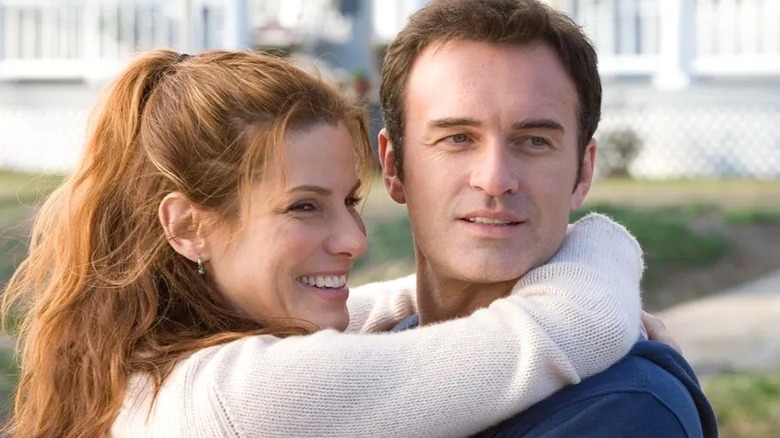
No matter how frayed and hard to understand Linda's situation becomes from a logical standpoint, there isn't one moment in the movie where she isn't completely understandable as a character, largely thanks to the acting prowess that's become a staple of every Sandra Bullock movie. This element of character cohesion is particularly important in a movie where the protagonist's arc is only intelligible to herself and the audience. And Linda's arc is a hugely significant one: Initially living a life in which she just goes through the motions each day without trying to exert much control over her present or future (as demonstrated by the mirrored montages of her routine at the start of the film), she is pushed by the time shenanigans into grabbing the bull by the horns.
Over the course of "Premonition," Linda gradually becomes more present in the here and now, aware of her ability to affect her surroundings. An example of this is yanking Jim out of his complacency and forcing him to confront his shortcomings as a husband. The ending of "Premonition" becomes especially tragic in light of that character development, as it represents Linda coming face to face one final time with what remains of her old, stagnant, comfortable life, and watching it erupt into flames. But there is also a tart hope in the ending's indication that Linda is ultimately able to process her tragedy and move on — something she might have had a lot more trouble doing if she hadn't gone through all that she did.
Like Jim, Linda's marriage couldn't be saved
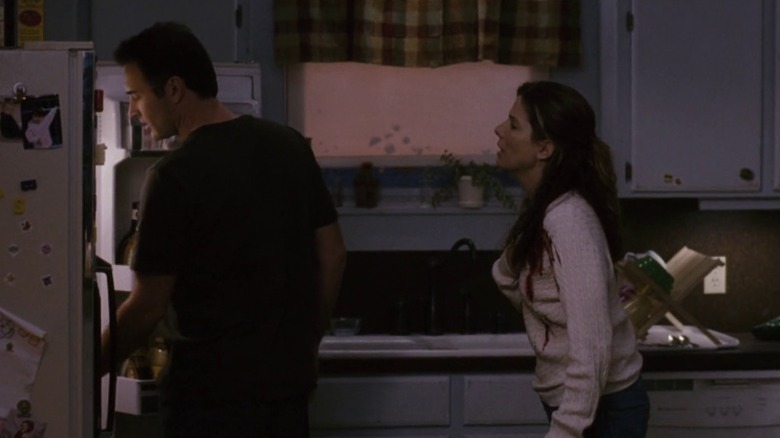
In a deeper sense, "Premonition" is the story of a crumbling marriage. After a prologue in which Linda and Jim move into their new home under the sepia glow of a warm memory, we move into a present that feels wrong even when it's right: Linda's housewife routine is droning and unexciting, Jim is constantly busy with work, Jim's demeanor at home is cold and distant. The viewer has already been given a sense that there's trouble in paradise even before Linda learns about Jim's affair.
Then, the revelation of the affair brings to the fore all of Linda's latent relationship insecurity. Her main conflict for a good deal of "Premonition" thus becomes an existential one. Before she can even start worrying about how to change her future, she has to grapple with what she wants her future to be. The imminence of Jim's literal, physical death acts as a sort of metaphor for Linda's understanding that her husband has become a stranger and for her uncertainty as to whether she still wants him in her life.
In the end, Linda decides that she does, and she goes to great lengths to try and prevent Jim's death. It's telling that this happens while they are discussing their relationship and making amends. But, bringing the metaphor to its conclusion, Linda cannot save Jim anymore than she can save her marriage; all she gets is a moment of temporary solace. She can't change fate, nor could she have saved a relationship that had long since stopped working.
The ending of Premonition followed the trend of the time

The ending of "Premonition" may come as a shock to those discovering the movie today, but it was very much on trend when it dropped in multiplexes back in 2007. Like the characters of "Final Destination" and "The Butterfly Effect," Linda Hanson is having her whole life consumed by confusion, doubt, and fear as she hopelessly attempts to course-correct her fate. Like the protagonists of "Memento" and "Gothika," her sense of self is being eroded by the unreliability of her own memory, reality, and perception of time.
Some of those precursors end on notes of tragedy, others on ambiguity, others still on relief and respite. The ending of "Premonition" combines all three of those possibilities. Just like a "Final Destination" movie, Linda ultimately learns that it's impossible to cheat death, leading to a deeply sad denouement. But, with the film having previously established that Linda is changing as a person as a result of her predicament, a door is left open for what we see in the epilogue: Linda, in "The Butterfly Effect"-esque fashion, having moved on and regained control of her life.
That this happens despite Linda's failure to prevent Jim's death makes the ending extra poignant. And this is where the "Memento"-style character ambiguity comes in: Notwithstanding the montage of marital bliss that closes the film, it's entirely possible that the only thing allowing Linda to view her past with such tenderness and draw strength from it to move forward is that she's no longer having to deal with the lived reality of Jim's inadequacy as a partner. Which is fine, really; what matters is that she now has something to fight for, and the will to fight for it.
What has Sandra Bullock said about the ending?

In 2007, Sandra Bullock sat down with Collider to promote "Premonition," and she spoke at length about the film's themes. Asked about whether she had a sense of things being inevitable in her own life, she offered her thoughts on the movie's iteration of that notion. In Bullock's view, "Premonition" manifests the idea that things need to have happened as they did in order to be as they are. She noted that she often looked for a purpose while dealing with someone's passing, and she found one in the thought that, as expressed in the ending of "Premonition," every event gives birth to something else that couldn't have existed otherwise.
"That is what I loved about ['Premonition'] is that it was bittersweet, that if one thing didn't happen the next thing that was supposed to begin in this world couldn't have arrived," she said. Does that mean that Bullock believes that all things are determined by fate? Not necessarily. "I do think we have a good amount of control of what our life can be," she added. "It's up to us to make our life happy and joyful and what it is supposed to be for us. So I think there is a level of control in that fated end, whatever you want it to be."
There's an alternate ending that makes no sense
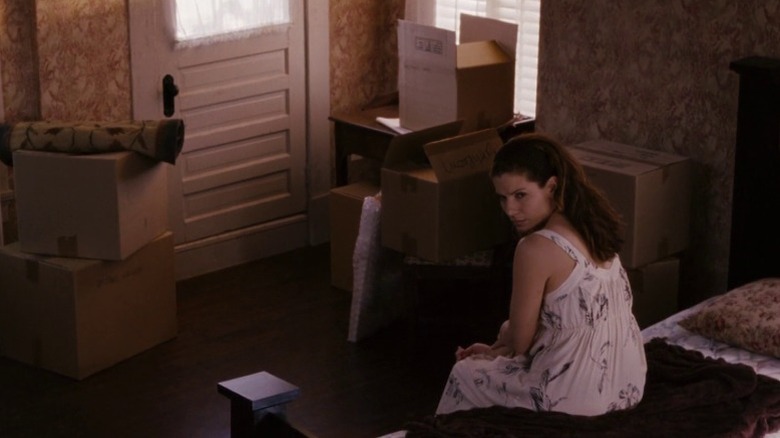
"Premonition" ends with a tragedy followed by a hopeful epilogue, but, in a different world, the movie could have instead leaned into the darkness of the story all the way to the closing credits. In an alternate ending that was included on the film's home media release, the scene where Linda sits up in bed after talking to her daughters about the moving truck is not the last one. Instead of getting up to reveal that she's pregnant, Linda hears church bells in the distance, and then notices the sound of someone showering in the suite bathroom. She walks slowly and warily into the bathroom as creepy music builds up, and the movie cuts to black after she opens the shower curtain and gasps. We never actually see who's behind the curtain, but it's strongly implied that it's Jim, somehow alive yet again.
It's probably for the best that "Premonition" stuck with the theatrical ending, because this alternate ending, to put it plainly, wouldn't have made any sense. While the scene itself works as an effectively creepy closer, Jim still being alive months later would be tantamount to "Premonition" crossing over from a time travel narrative to an outright ghost story — not a concept you want to introduce in the last scene of your movie with no set-up at all. Either that, or, in a different interpretation, Linda's mind would be in complete disarray, which would be a cheap and unsatisfying conclusion to a movie so driven by her personal journey. The theatrical ending may be less of a stunner, but it's pretty clearly the most fitting one.